
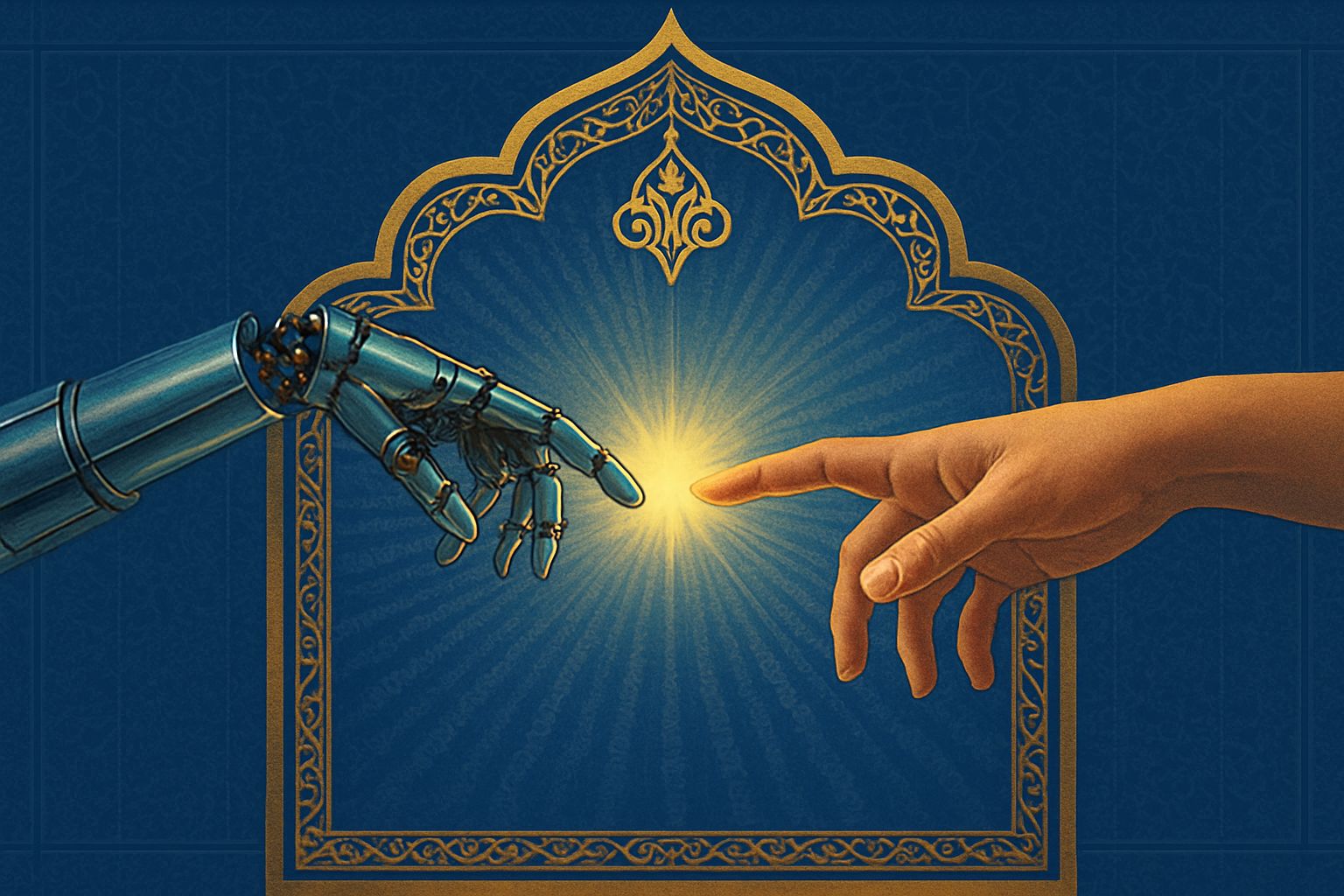
In 2025, the United Nations declared the International Year of Quantum Science and Technology (IYQ), a recognition that was powerfully echoed when the Nobel Prize in Physics was awarded to quantum researchers. Both honours signal that quantum research has leapt from theory into a domain of profound economic, political, and ethical consequences. Quantum computing, sensing, and communication promise revolutionary change, from climate modelling and materials discovery to drug design and national security.
Yet, as with every technological revolution, these breakthroughs come with disruption, inequality, and uncertainty. We stand at a crossroads. Will this revolution be guided by compassion and justice, or will it accelerate without a moral compass? For Muslim thinkers, this moment calls for a deep understanding of our times (fiqh al-waqiʿ), guided by Islam’s vision of mercy for all creation (raḥmatan lil-ʿālamīn) and the higher objectives of Islamic law (maqāṣid al-sharīʿah). The Islamic scholar views, such as Nahdlatul Ulama (NU) rooted in moderation and compassion, should offer not just a critique of technology but principles for designing it ethically. In this context, spiritual intelligence is not an accessory; it is a necessity.
Quantum Technologies: Great Power, Great Perils
Quantum science unlocks a hidden layer of reality where particles defy everyday logic. Imagine electrons existing in two places at once, or entangled particles influencing each other instantly across vast distances. By harnessing these strange phenomena, quantum technologies gain unprecedented power. A mature quantum computer could solve problems far beyond the reach of today’s supercomputers, revolutionising medicine, finance, and artificial intelligence.
Quantum communications promise unhackable networks, whilst quantum sensors could monitor our environment or our health with incredible sensitivity. This is why many believe quantum technology will spark the next global revolution. However, with great power comes great peril. The same quantum computers that could cure diseases could also break nearly all current encryption, putting our hospitals, banks, and governments at risk. Quantum sensors could enable total surveillance, potentially seeing through walls or tracking entire populations. Without just and fair governance, such power could lead to a new form of digital colonialism, where poorer nations become transparent to richer ones, deepening global inequality.
These are not merely engineering problems; they are moral ones concerning justice, trust, and our responsibility as stewards (khalīfah) of this planet. Who will own quantum data? Who will decide how it is used? If quantum security protects only corporate elites while small businesses and public services remain exposed, we betray the principles of justice (ʿadl) and trust (amānah). As the great scholar Imam Al-Ghazālī warned, knowledge without guidance “corrupts more than it benefits”.
New Ethical Dilemmas in the Quantum Age
The quantum world also presents new ethical challenges. Unlike traditional computers, quantum algorithms can produce correct answers through processes that are impossible for the human mind to fully trace. A decision made by a quantum machine might be verifiable but completely opaque. How can we ensure fairness or hold anyone accountable when the reasoning behind a decision is beyond our comprehension?
This “quantum opacity” threatens the core principle of responsibility (masʾūliyyah). Islam insists that every action carries accountability — “Whoever does an atom’s weight of good will see it, and whoever does an atom’s weight of evil will see it” (Qur’an 99:7–8). Yet if even developers cannot explain their machines, we risk delegating moral agency to systems devoid of intention (niyyah). Hence, ethics must precede (or walk along) engineering and development. Muslim scholars, philosophers, and policymakers must sit at the table alongside scientists to ensure that quantum design reflects values of transparency, equity, and humility before the limits of human knowledge.
Moral Compass for the Quantum Era: The Maqāṣid al-Sharīʿah
Centuries ago, scholars like Imam al-Ghazālī and al-Shāṭibī outlined the maqāṣid al- sharīʿah: the five core objectives of Islamic guidance, which are the preservation of faith, life, intellect, property, and lineage. These timeless goals provide a powerful moral framework to steer technological innovation towards human dignity and ecological balance.
1. Preserving Life (ḥifẓ al-nafs):
This principle demands that quantum breakthroughs in healthcare and environmental monitoring serve everyone, not just the wealthy. In an age of ecological crisis, preserving life also means protecting the natural world that sustains us. Quantum technologies can be used to track pollution, develop sustainable energy, and monitor our climate, turning this principle into an act of environmental stewardship. Such applications transform the preservation of life into environmental stewardship, echoing the Qur’anic reminder that “corruption has appeared on land and sea because of what people’s hands have earned” (Qur’an 30:41).
2. Preserving Intellect (ḥifẓ al-ʿaql):
This remains both a moral duty and a strategic necessity. Inclusive quantum education, rooted in pesantren (Islamic boarding school) ethics of knowledge as worship, can ensure that Indonesians at every level participate in shaping, not merely consuming, new technologies. “Say: Are those who know equal to those who know not?” (Qur’an 39:9). Cultivating intellect here also includes cultivating moral imagination, to train minds that can innovate without losing sight of meaning.
3. Preserving Property (ḥifẓ al-māl):
In our digital world, data, algorithms, and digital infrastructure are new forms of wealth and trust. Governments must treat post-quantum cryptography as a public good, securing hospitals, cooperatives, and small enterprises alike. The Prophet ﷺ said, “The property of a Muslim is sacred.” Today, that sanctity should extend to digital assets and civic data. Protecting them from exploitation fulfils the Qur’anic injunction to consume not one another’s wealth unjustly (Qur’an 2:188).
4. Preserving Lineage and Society (ḥifẓ al-nasl):
This principle requires that quantum progress strengthen, not fracture, communities. As automation and advanced computation reshape labour markets, societies are obliged to build pathways for reskilling and fair transition, ensuring that no generation is sacrificed to efficiency. Social cohesion and justice (ʿadl) become the measure of authentic innovation.
5. Preserving Faith (ḥifẓ al-dīn):
This anchors all other goals. It reminds humanity that knowledge and power are trusts (amānah) to be exercised with humility. The Qur’an declares, “He has made you khalīfah (stewards) upon the Earth” (6:165). Stewardship here implies not only moral responsibility but also ecological responsibility. Quantum science should therefore cultivate awe rather than arrogance, serving the sanctity of creation, not dominion over it. In this light, sustainability becomes a form of worship: conserving resources, minimising waste, and designing technologies that honour the balance (mīzān) set by God in creation. “And the sky He raised, and set the balance, so that you do not transgress the balance” (55:7-8). To preserve faith is to recognize that every act of discovery must deepen gratitude, not greed.
Applying maqāṣid turns ethics into policy. It reminds policymakers that quantum advancement without moral foresight embeds inequity into its code. Conversely, embedding ethics from the outset, through inclusive education, open standards, and green research, creates legitimacy and trust.
A Wisdom for the Future, Rooted in the Past
The idea that science can flourish within a spiritual framework is not a modern theory but a historical fact, proven during the Islamic Golden Age. Thinkers of that era, from Al-Farabi to Ibn Khaldun, were often polymaths who saw no conflict between reason and revelation. For them, scientific inquiry was an act of devotion, and knowledge was a sacred trust (amānah) meant to serve humanity.
The decline of science in the Muslim world was not a failure of faith, but a failure to uphold this integrated tradition. The quantum age calls for a revival of this essential balance. The strange principles of quantum mechanics—with its inherent uncertainty and deep interconnectedness—challenge our classical notions of control and predictability.
This scientific reality can be a source of humility, reinforcing the spiritual wisdom that all human knowledge is partial. It reminds us that to be true stewards (khalīfah) on Earth is to innovate responsibly, pushing boundaries while remaining anchored in moral consciousness. This perspective transforms spiritual intelligence into a practical discipline: an awareness that every qubit and every algorithm is part of a created order entrusted to us. The question, therefore, is not only whether we can build quantum supremacy, but also whether we can achieve moral supremacy—a civilisation where technology serves life, intellect, and justice for all.
Conclusion: A Faithful Quantum Future
The quantum revolution will test humanity’s character as much as its intellect. It is a profound moral test, asking whether our technological progress can remain grounded in justice and whether we can innovate without leaving the vulnerable behind. For the global Muslim community, this is a call to leadership—to show that a deep understanding of faith (tafaqquh fid-dīn) and a deep understanding of knowledge (tafaqquh fil-‘ilm) are not separate pursuits, but the twin wings of true progress.
Fusing them is the key to imbuing this revolution with spiritual intelligence. This means creating quantum labs that remember compassion, classrooms that teach ethics alongside equations, and policies that marry cutting-edge innovation with timeless principles of justice and mercy.
If we succeed, the future of quantum technology will belong not to machines in isolation, but to the humanity that guides them with wisdom. This holistic approach can ensure the quantum age fulfils its tremendous promise as a blessing for all, truly embodying the Qur’anic vision: “We have not sent you, [O Muhammad], but as a mercy to all creation.” (21:107) Wallāhu a‘lam (Allah knows best).
Writer: M. Nabil Satria Faradis (Special Staff to the Rector of Universitas Nahdlatul Ulama (UNU) Yogyakarta, Doctoral Researcher at the University of Cambridge)
Pemikiran dan Refleksi Diaspora Nahdlatul Ulama (PR Di NU) merupakan ruang bagi gagasan, refleksi, dan kontribusi intelektual dari diaspora Nahdliyyin. Platform ini menyatukan wawasan yang berakar pada keahlian masing-masing para diaspora NU yang menawarkan perspektif tentang Islam yang berlandaskan Indonesia sebagai masyarakat yang dinamis, dan tentang nilai-nilai Nahdlatul Ulama yang tetap relevan di dunia saat ini. Fokus “PR Di NU” adalah isu-isu mendesak abad ke-21, terutama di bidang Science, Technology, Engineering, dan Mathematics (STEM). Tema-tema seperti etika Islam dalam kecerdasan buatan, keberlanjutan lingkungan, kesehatan digital, energi, dan transformasi sosial berfungsi sebagai gerbang untuk memperkaya percakapan global melalui lensa Ahlussunnah wal Jama’ah. (Editor Utama: Efri Arsyad Rizal)